Gospel commentary index Lectionary Year A

On this page, you can find an index to all the commentary articles on the gospel lectionary readings for the whole of Year A, together with links to the video discussions between Ian and James. The articles will be reposted with updates during the year—but they are listed here for convenience and planning ahead.
Does ‘love’ in the New Testament mean what we think it does?
The term ‘love’ is clearly important in the New Testament in a range of contexts. But modern use of ‘love’ shifts its meaning into all sorts of different areas. One solution to this has been to distinguish the different Greek terms for ‘love’ in Scripture. But this approach does not stand scrutiny, so cannot solve the problem. But there is another, better, solution which can help. The problem I was rather struck by one part of the discussion last week about the contribution of the late Richard Hays to New Testament ethics, and his decision not to use ‘love’ as…
The people of God in Revelation 7
The lectionary reading for All Saints in Year A is Rev 7.9–17—an extraordinary vision of the people of God, which begins at the start of the chapter, in the interlude…
What is the role of the New Testament in Christian ethics?

The late Richard Hays’ book The Moral Vision of the New Testament was a landmark work that offered a serious, structured approach to the question of how the New Testament should…
Should Christians ‘man up’?

There has been a growing movement claiming that Christianity calls for a certain kind of masculinity, protesting against a perceived feminisation of the faith. Is there any grounds for this?…
The French being French? What is behind the recent riots?

Mike Starkey writes: It’s early afternoon on Friday 16 October 2026. I enter the public transport office in central Strasbourg, next to the Alt Winmärik tram stop. Alt Winmärik means…
Paul’s suffering and boldness in 1 Thess 2
In the epistle for Trinity 21 in Year A, 1 Thess 2.1–8, Paul and his co-authors explain their approach to ministry, but do so by appeal to what the Thessalonians…
Is baptism by immersion Anglican?
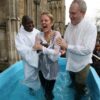
Why was a faculty application for a portable baptismal pool in a church in Southwell and Nottingham rejected? What does that tell us about processes in the Church of England—and…
What exactly do we ‘render unto Caesar’ in Matthew 22?

The gospel reading for Trinity 20 in Year A is Matthew 22.15–22, the short exchange between Jesus and his opponents on the question of the Roman ‘poll’ tax. This has…
What can we learn from The Cauldron of the Middle East?

The situation in the Middle East dominates our news—yet so much comment is woefully ill-informed. What do we need to understand, and how can the Church remedy its failure to…
Paul’s affirmations in 1 Thessalonians 1 video discussion
Paul’s opens his earliest letter, 1 Thessalonians (the reading for Trinity 20 in Years A) with a range of remarkable affirmations. Already he is expressing in nuce things that he…
How should the Church of England respond to the Green Party’s antisemitism?

The Green Party has become one of the most extreme in the UK following its annual conference. If the Church of England bans clergy from being members of other extreme…